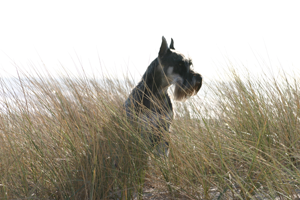
Bringing Home a New Puppy
Supplies to have when you bring your new Standard Schnauzer puppy home.
Of course you're thrilled about bringing home a new puppy.
They, too, will be excited - curious enough
to run about your house, poking their nose into everything. But before you bring home your new puppy,
spend some time puppy-proofing your home and gathering the supplies you'll need to start your relationship
on a happy, even keel. Your puppy is a baby. Like all babies, they need lots of love and cuddling,
rest and sleep, lots of good, nourishing food and more love.
Moving to a new home, leaving their mom and littermates and the only people they have ever really known is a very difficult experience for the puppy, so try to make the move as easy as possible for them. For the first few weeks, try to change their life as little as possible.
Stock Up on Puppy Supplies
Scout out your neighborhood for pet supply stores and establish a relationship with them.
Think ahead to bad weather or times you'll be really busy. Are store hours convenient?
A soft, adjustable collar with identification tags and a leash.
Here's a basic list of what you'll need to get before the pup arrives:
Bowls for food and water. Glass and ceramic can break; plastic is chewable and can harbor bacteria. Stainless Steel is sturdy and easy to wash and the best choice.
A crate to serve as their den. Wire is more portable than Plexiglas and allows for better ventilation in warmer climates. Since your puppy will grow, you may want to buy one that can be sectioned off to allow for expansion. Or, be prepared to buy a new one in several months.
A bed and accessories. For most dogs, especially at the beginning, crate padded with washable towels or blankets. You might want to have a hot water bottle on stand-by. A ticking clock and a sturdy, dog-proof stuffed toy may also keep her company the first few weeks.
Safe toys
Don't buy too many at first, but have enough to keep them distracted from chewing your shoes
and furniture. Check the labels and look for quality pet approved dog toys, same as when you
buy toys for children. Be sure that parts won't break off. Buttons, plastic shards and small
balls can lodge in her throat and block air passages. Most rawhide products should be avoided.
Balls should be softball size to be safe. Nyla bones, sturdy tug ropes and things that will
spark interest are the best choices as is a hard ball. I avoid Greenies as they have killed
dogs by lodging in the intestines.
Grooming tools
Brush, Comb, Flea Comb, Shampoo (made for dogs) (occasional bathing), also a Dremil or Nail
clippers, and Clippers for grooming. An anti-biotic ointment, Benadryl,(capsule) - Use this
if the dog is stung by a bee/insect, and has minor allergy, Pepto Bismol for minor stomach
upset and Kaopectate for minor diarrhea.
Baby gates
It will be some time before you can trust your puppy to roam the house alone.
Baby gates, vetted for safety by consumer organizations, protect her and your belongings.
Use them to block off stairways, carpeted rooms and other forbidden areas.
Puppy food.
Changing their diet abruptly may cause stomach distress. If you want to change foods, phase
them in by mixing the new puppy food with their old brand for a week. We feed the puppy an ALL
STAGE dog food; which is good for all ages. We are currently feeding them a Costco/Kirkland brand
that is "Natures Domain Salmon Meal and Sweet Potato" which is grain free or Sam's Club/Members Mark
"Exceed" Salmon and Pea formula.
Put Away Poisons and Precious Possessions
If your home, garage and yard make for a puppy wonderland of chewy sneakers,
enticing power cords, sweet-smelling antifreeze, warm and fragrant flower beds, dolls with button
eyes and hanging drapes with tie-back tassels, sweep through and put them away NOW. Digestive tract
X-rays of sick dogs have revealed all sorts of unusual things, from ribbons, spoons and dominoes to
knives with blades six inches long.
Look at your home as your puppy sees and smells it. You might want to keep your kids' rooms off
limits for a while. Close closet doors and be sure that cabinets are secured. Hide electrical cords
under carpets. Put knick-knacks out of reach. Lock up anything chemical, from soaps, waxes and
cleaning solvents to medicines and cosmetics. Certain human foods and plants such as English ivy
and tiger lilies are poisonous, too. If in doubt, use caution and assume its bad and don't
let her get around it.
Puppy-proof the contents of your garage. Put away ethylene-glycol antifreeze and other automotive compounds,
fertilizers, pesticides, paint, nails and anything else that may cause trouble if swallowed.
Make sure your backyard fence is in good repair, so your puppy can neither jump over nor dig under it.
Fence off flowerbeds and trees and check for a long list of poisonous plants, including boxwood,
bulb flowers, hemlock and sage. Watch out for uninvited milkweed, poison ivy, oak and sumac, too.
Make sure to pick up objects like shovels, small rocks, kids toys, trash or other things she may want
to eat including any type of plastic bags.
Rehearse Your Family's "Puppy Speak"
Agree on a game plan for keeping the puppy warm and calm during her first days with you.
Your puppy will want to please you and will be eager to learn how, but she'll also be nervous.
Every member of your family must give uniform commands. "Sit," "stop," "down," "kennel," "come"
and "stay" must have the same meaning, no matter which family member uses them. For show and
confirmation you want the puppy to know the command "Stand" for in the ring and not Sit.
Check for kindergarten puppy classes; obedience class for the day and times in your area to
help socialize and keep everybody on the right track. We highly encourage this process to
make the training of your new pup a more productive member of your family.
Write up the schedule you'll use for your pup's first few days home. The puppy needs you to be
regular and consistent. Don't invite the neighborhood over to welcome your new dog.
Brace yourself now, so you don't yell at the pup when she soils the carpet or bites off Barbie's head.
She won't know any better at first.
Have a Vet to Turn To
Your puppy will probably come home with medical and inoculation records.
If you don't already have a family vet, ask friends to recommend one. Have your puppy checked
over by the vet you choose within the first week for a puppy exam. That way, you'll be
prepared for emergencies before they happen.